In our first cycle for 2018 (starting Thursday 8th March), we tackle the church! What is the church, and what’s it for? In the economy of God’s mission and peace-full reign, how is Christ’s body to engage, even change, the world? In other words:
How might the church’s life of worship when gathered together serve its work in the world when scattered and sent into a post-Christian culture?
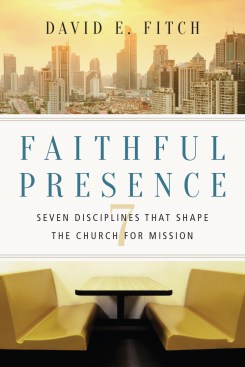 Our conversation partner is Professor David E. Fitch, missiologist and founding pastor of Life on the Vine Christian Community and Peace of Christ Church, both in Chicago. The book? Faithful Presence: Seven Disciplines that Shape the Church for Mission (2016).
The title borrows from James Davison Hunter’s landmark 2010 book, To Change the World: The Irony, Tragedy, and Possibility of Christianity in the Late Modern World. As summarised here, Hunter dismantles prevailing political theologies and popular wisdom concerning how the church is to engage and change the world. Most strategies founder on triumphalism (evangelicalism & radical orthodoxy) that tries to take over the culture one individual at a time, or pietistic escapism as a counter-culture on the margins (anabaptists) that largely leaves the culture to rot. Instead, Hunter calls for a different paradigm of Christian engagement with the world, that being “faithful presence”—an ideal of Christian practice that is not only individual but institutional; a model that plays out not only in all relationships but in our work and all spheres of social life.
Unfortunately, as critiques here and here demonstrate, Hunter at times caricatured these communities, ignoring what they look like at their best. And more importantly, for our purposes at least, his proposal was largely abstract and theoretical, hinting at a strategy but never mapping out the path. Does this call for cultural persistence constitute a program, a project, or a reworking of the church itself geared up for mission? Hunter leaves us wondering.
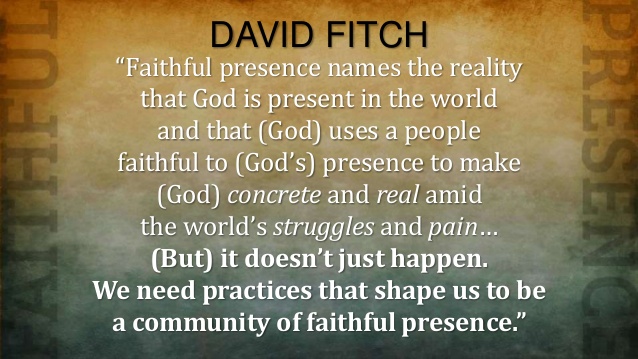
 Thank God, then, for Fitch. He steps in with a more embracing theological vision of God’s faithful presence across biblical history. He presses back on Hunter, revealing that the church itself, in its very inner life and rhythms when rightly constituted, is a counter-politic embodying God’s peace-full reign. And that’s all by Chapter 2. (For a 3 minute grab of why Fitch thinks we must move “from gospel presentation to kingdom presence” see here. This emphasis on “faithful presence” as seen in Luke 10, the sending of the 72, gives us a poignant image of “eucharist on the move, extending the presence of Christ into the world.”)
The rest of the book is dedicated to outlining seven disciplines/practices through which we are formed to host God’s faithful presence, and recognise/call-out this presence in the wider culture in a non-coercive way, through which our Triune God changes the world. (For a slick graphical summary of the book, see Vintage Church’s slide-show here.)
The practices?
- The Lord’s Table (hospitality)
 Reconciliation (peace-making)
- Proclaiming the Gospel (preaching the Word)
- Being with the “Least of These” (care/compassion)
- Being with Children (nurture/education/discipleship)
- Fivefold Gifting (shared non-hierarchical leadership)
- Kingdom Prayer (intercession)
(You may notice close parallels with Mike Frost’s B.E.L.L.S. (Bless, Eat, Listen, Learn, Sent) in his excellent little 2015 book, Surprise the World: The Five Habits of Highly Missional People. Simple summaries and resources here, here, and here.)
Fitch corrects the maintenance mode of a church turned inward on itself (where the world serves the church and thus the church is irrelevant to the world), and equally addresses the exhaustion that comes from a missional church pressing every act as in service of outreach (thus making the church merely an instrument, undermining worship for the end of God’s glory, and tiring out members as they leave the church to serve the world). Instead, he offers a seamless missional ecclesiology … a way of being the church that is itself a witness in the world. (For a meaty dialogue between David Fitch and Scot McKnight, highlighting some points of difference in theology and practice, listen to this mp3 podcast from Northern Seminary here.)
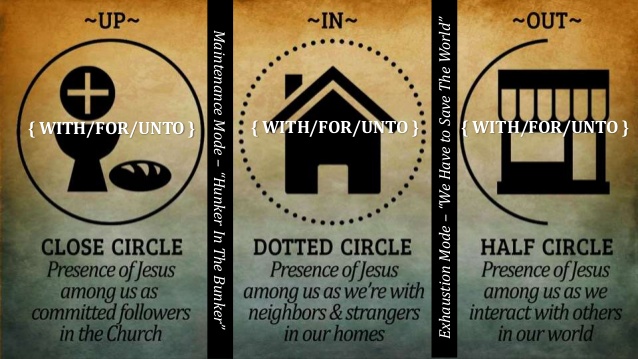
It puts flesh on much of what we do in Christ’s Pieces. God hosts us in the “close circle” of Christian fellowship (much like Quarry, practicing the disciplines every Sunday, and Open Book, going deeper in formation). We then make space to host God’s faithful presence around the tables of our homes (like Open Table). In turn, this mixed community is formed to recognise and carry/bear God’s transforming presence as our wider post-Christian culture hosts us, whether in their homes, at work, study or play (our mission as church scattered). God’s transcendence and immanence unite in this Spirit-filled community. Mission and incarnation work in synergy, rather than dividing a fellowship down the middle to either serve home base or go it alone on the margins.

So, this book is timely for us. Whilst it’s American in origin, the illustrations map easily onto our Aussie context and especially our intentional Christian Community. Studying Faithful Presence and putting these disciplines into practice is a brilliant opportunity to grow together, and see our communal life opened for the peace and transformation of our local community.
Details below, and all welcome, whatever your faith commitment, tradition, or none.
+++
Over 5 Thursday sessions (March 8 – April 26) at Nik & Dave’s house (152 Tanderra Way, Karana Downs; directions here) we will dialogue with David Fitch and each other, learning how to host God’s faithful presence for the sake of the world.
OPEN BOOK, THURSDAYS 7PM | David Fitch’s Faithful Presence (FP)
(Click session # hyperlink for liturgy/ppnt slides)
March 8 |FP 1, pp. 9-43: Intro + Ch. 1 “God’s Faithful Presence” + Ch. 2 “To Change the World” [n.b. FP 2 is only one week later, not fortnightly]
 March 15 |FP 2, pp. 47-92, 189-195: Ch. 3 “The Discipline of the Lord’s Table” + Ch. 4 “The Discipline of Reconciliation” + Appendix 1 “What Formation Looks Like Around the Table” + Appendix 2 “The Indispensable Role of the Dotted Circle in the Disciplines”
March 29 |FP 3, pp. 93-129, 197-205: Ch. 5 “The Discipline of Proclaiming the Gospel” + Ch. 6 “The Discipline of Being with the ‘Least of These'” + Appendix 3 “Extending the Presence: An Alternative Basis for Ecclesiology and Mission”
April 12 |FP 4, pp. 131-165, 207-209: Ch. 7 “The Discipline of Being with Children” + Ch. 8 “The Discipline of Fivefold Gifting” + Appendix 4 “Where Is the Church? A Closer Look at Matthew 25”
April 26 |FP 5, pp. 167-185, 211: Ch. 9 “The Discipline of Kingdom Prayer” + “Epilogue: How God Changes the World” + Appendix 5 “A Simple History of the Disciplines from New Testament Church to Christendom”

PS – originally we had planned to study Sam & Sara Hargreaves, Whole Life Worship: Empowering Disciples for the Frontline (buy here; accompanying website here with extra resources here) … promo video here. Though we’ve opted instead for Fitch’s Faithful Presence, this book is still excellent for a focus on the nature of worshipping God as arguably the central purpose of humanity (theologically understood). But what is worship? Is it just singing songs? And how does what we do on Sunday as the Church Gathered, relate to our worldly work Monday to Saturday as the Church Scattered? Similar to the focus for this series, our core question was to be: What does it mean to worship God with our whole lives, where Sunday’s liturgy is a springboard to every day’s worshipful service?
 As one who loves rock-climbing, snapped his neck in a gymnastics accident, and still commutes on a motorbike most every day, I get this
  Definitions vary, but pay attention to the valence. Risk has a negative aspect. It’s the possibility of loss or injury: peril; someone or something that creates or suggests a hazard. In other words, risk is the exposure to the likelihood of injury or loss; put simply, it’s a dangerous and chancy choice.
 It’s no artificial segueway to see that this is now about that. This worldly risk is also about that greater good. As
  Turning to the biblical story, then, we might rightly wonder if the Triune God—Father-Son-Spirit—is prone to risk-taking? Can God even take a risk, given the above definition? If you hold to the medieval philosophical framing of God being, by definition, omniscient (all knowing), omnipotent (all powerful), omnipresent (everywhere), and ultimately
 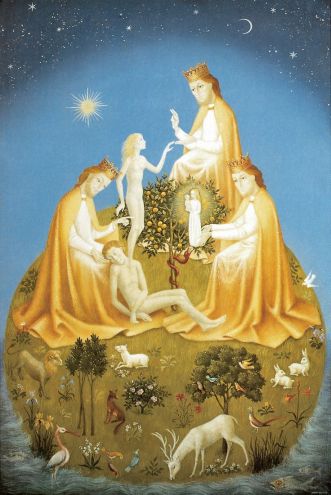 Test case: Creation. The all-sufficient Risk-Taker whose essence is communion, overflowed in the perichoretic dance to creatively birth the cosmos. The motivation was love, and the reward was shalom, weaving us together through right relationship with God, neighbour, self and creation, all pointing back to its transcendent source. The risk is for everyone, not simply God in a zero-sum game; holistic flourishing, like African
 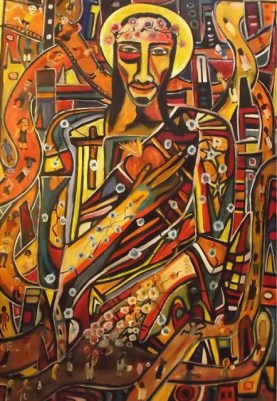 Like I said, though, Christmas is a time of injury.
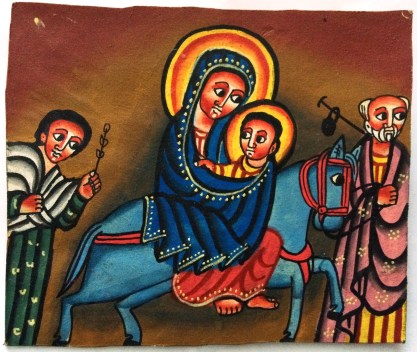 The unlimited, all knowing, all powerful Creator, tied himself to matter and was confined to a crib in a baby’s body. God hurt. And forget those romanticised Christmas carols: “meek and mild, no crying he makes”. No, this was first century Palestine, no more peaceful than today (cf.
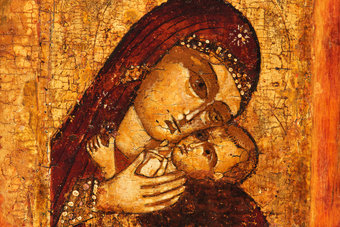
  It’s captured well in the iconic Greek Orthodox painting “Slaughter of the Innocents”. Granted, the statistics suffer symbolic inflation over this feast honouring the “
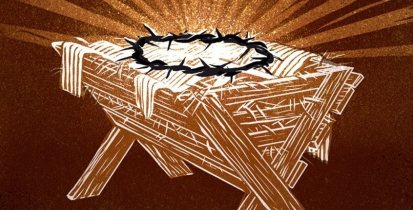
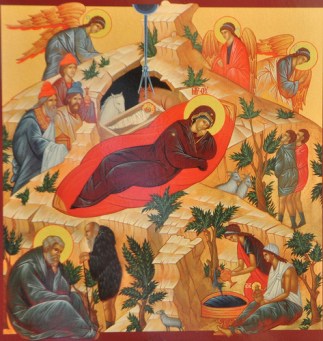 The risk of incarnation led inexorably to the crucifixion, the final relinquishment of divine power, not for personal gain, but that all may be set free from the ultimate demonic despot, finding life in renewed relationship with God, neighbour, planet and self. Literally, this risk offered a sign, a fore-taste, of “
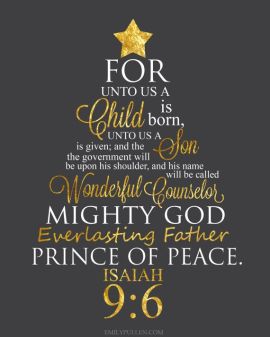 Transposed into the modern world, where facing today’s Herods requires the combined courage of Mary and the Messiah, Chesterton composed this poem:
 And the mother still joys for the whispered
 Returning, then, to our key theme, and inspired by Parker Palmer’s
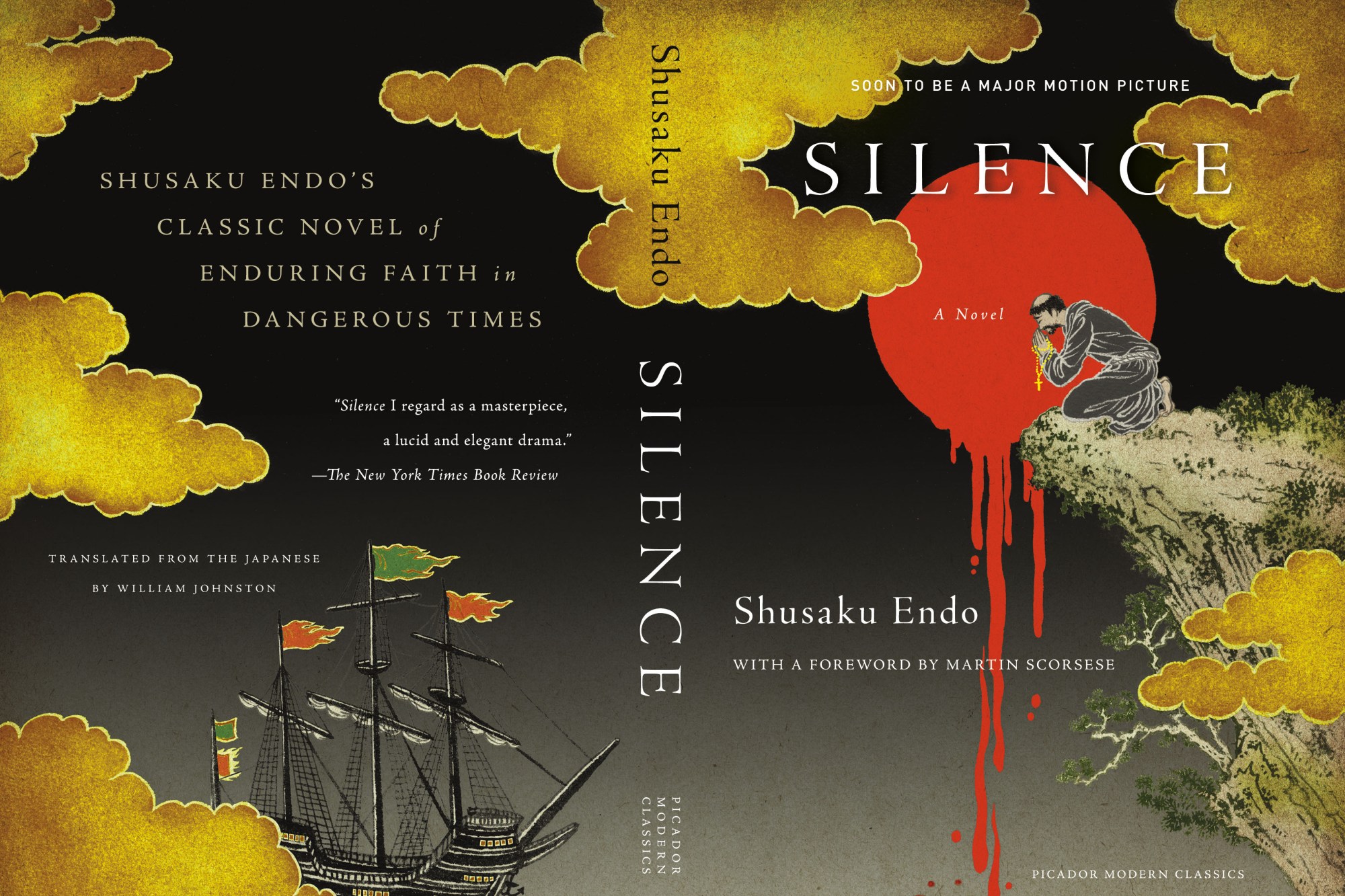
 Endō, a Japanese Catholic, was no stranger to occupying the place of the Other: too foreign, too Oriental, to be understood by the West, and too Christian, too iconoclastic–not to mention insufficiently Buddhist–to be accepted at home. His work of historical fiction is set in 1635 as Portuguese missionaries seek to proselytise the Japanese during a time of extreme persecution. Following rumours of their leader (Ferreira) abandoning his faith, two younger Jesuits (Fr. Rodrigues and his companion Fr. Francisco Garrpe) head to Japan to uncover the truth and shore up the struggling converts. How will this collision between cultures resolve, as each grapples with the other? Will Rodrigues and Garrpe, too, betray their Lord, trampling his crudely formed icon (
 We must, however, count the cost. Incarnation always leads to the cross.
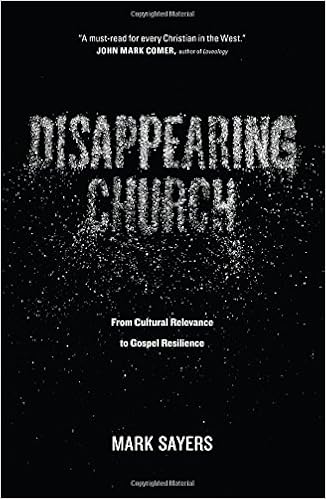
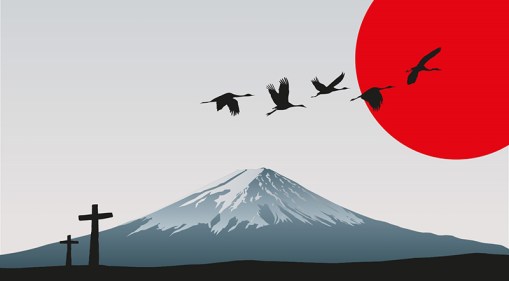 Recapping this first point, then, our times increasingly resemble the novel’s setting. Christianity, once popular and even powerful, is on the outer, and a nation “come of age” is prone–with some good reason–to marginalise and even persecute the Church as a threat to the common (read “secular”) good. As missiologist Lesslie Newbigin argues powerfully (see
  Mercifully shorter than my first rationale, a second reason this book is timely to discuss is that the much anticipated movie rendering of Silence by Martin Scorsese has come! Thirty years in gestation since first reading, this master director describes its production as his own “pilgrimage”. It’s set to be released in Brisbane on February 16, 2017. God willing, we’ll watch it together on Thursday March 2. Obviously watching the movie, mid cycle in Open Book, comes with a complete “spoiler alert”! That said, his adaptation is receiving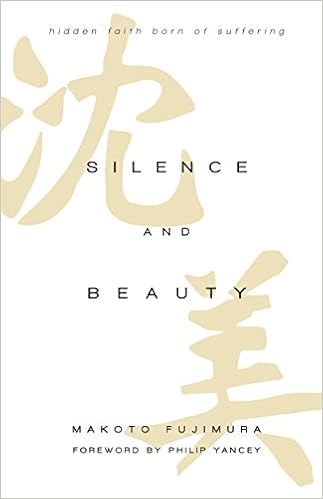

 Christ's Pieces