In our first cycle for 2019 (starting Thursday 14th March), we consider a conundrum. Jesus said it is by our love for each other that the reality of God is made known to the world (John 13:34-35). Love is the church’s greatest apologetic in this post-Christian culture that cares little for religious dogma and commitment. And yet, how can our community demonstrate this kind of love, if we don’t even understand our neighbour? Her drives and core motivations? His fears and insecurities? Crystallising these questions, I’m wondering:
How might accurate self-knowledge shape the way we love each other and our witness to a watching world?

Over four fortnightly sessions (schedule below), Ian Morgan Cron and Suzanne Stabile will be our conversation partners. We’ll dive deep into their book, The Road Back to You: An Enneagram Journey to Self-Discovery (Downers Grove, IL: InverVarsity Press, 2016).
Speaking frankly, I find most personality tests frustrating, even as I can see their purpose, like the Meyer-Briggs/16Personalities and the Gallup Poll’s StrengthsFinder. It may well be my personality type (!), but I’m suspicious of how they compartmentalise your identity into fragments like introvert vs. extravert, thinking vs. feeling, sensing vs. intuition, and judging vs. perceiving. Personally, I’ve changed a lot since my early days in youth work, later losing my head in the books, and now lecturing in higher education.
But what’s largely remained constant is the core motivation driving my decisions, and my strong tendencies, whether healthy and relaxed or stressed and under pressure, to adopt certain patterns of behaviour in dealing with a complex world and confusing people therein.
That’s where the beauty of this repackaged ancient wisdom in the Enneagram is apparent. The deeper I’ve looked, and the more conversations with devotees I’ve had, it keeps life together and is the most powerful tool I’ve found to truly understand both myself and my neighbour, thus learning to love as a witness to a relationally dysfunctional wider world. A model for healthy relationships may be one of the greatest gifts the church can give a post-Christian culture. That is, of course, if it’s a gift we already possess.

True, we could have read any one of the experts on this tool, whether Don Richard Risso and Russ Hudson’s The Wisdom of the Enneagram (text here) with their precursor Personality Types and simple follow-up Understanding the Enneagram, or Franciscan contemplative Richard Rohr’s book alongside countless talks and videos on the topic. And you might find it helpful to browse some key sites and organisations like The Enneagram Institute and The Enneagram Academy, taking free tests (here, here and here) or paying for a more accurate assessment (here and here). After getting my results, it’s somewhat helpful to know I’ve been placed as a Type 1 Reformer–closely followed by a Type 5 Investigator–with an equally strong Type 9 Peacemaker and Type 2 Helper wing (1w9/2). But, frankly, I’m more interested in discovering this through conversation and dynamics among friends, rather than being boxed by a survey. (Again, perhaps my personality type aversion to imperfect systems!)
Thus the beauty of Cron and Stabile’s book. They synthesise many of these frameworks into an accessible and engaging read, seeing the non-reducible person at the centre, and placing this informative schema within a Christian theological frame. Each type is considered from childhood to adulthood, at work and play, alone and in relationship, when healthy and unhealthy, in terms of strengths and weaknesses, even mapping a path toward transformation guided by prime examples.

To give you a jump start into the 9-types of personalities and core drivers, listen to an interview with them on the Liturgists podcast (page/youtube), check out their web site and original podcast, and see what it looks like relationally through interviews on Ian Morgan Cron’s Typology podcast or by reading Suzanne Stabile’s The Path Between Us (2018). I’ve also enjoyed listening to the band “Sleeping at Last“, with their Atlas Album featuring 9 Enneagram songs (e.g. Type VIII Challenger here) and lyric videos (also here).
All of this encouragement aside, we also need to critically assess some questionable ties between the Enneagram and Kabbalistic mysticism/New Age syncretism, such as examined here and here. Studying this book shouldn’t be read as a whole-hearted endorsement of all the authors say and do; rather, it’s recognition that there’s something worthy of further exploration, even if–as Augustine aptly said in City of God–we must “despoil the Egyptians” to repurpose pagan tools for godly ends.
All of this will come out over four weeks of dialogue, as you discover your type with its infinite varieties, and learn how to love those different to you.
Even so, here’s a snapshot of the nine (ennea in Greek) personalities. The figure (gram) depicts arrows away from a type showing how your personality shifts to take on unhealthy aspects of another core motivator when stressed (as a Type 1, I become sullen like a depressed and jilted Romantic Type 4 when my ideals are endangered), and arrows toward your number indicating the positive energies you draw from another type when feeling secure (when happy I ride my motorbike way too fast, climb mountains, incessantly socialise and seek risky adventure like a Type 7 Enthusiast).
There’s a more detailed summary both here and here (click hyperlinks for more), and the following hyperlinks to pictures come from Derek Bruff’s @doodlinginchurch here.
Here’s the lowdown. At a glance, which seems most like you, and your core motivation?
TYPE ONE: THE PERFECTIONIST. Ethical, dedicated and reliable, they are motivated by a desire to live the right way, improve the world, and avoid fault and blame.
TYPE TWO: THE HELPER. Warm, caring and giving, they are motivated by a need to be loved and needed, and to avoid acknowledging their own needs.
TYPE THREE: THE PERFORMER. Success-oriented, image-conscious and wired for productivity, they are motivated by a need to be (or appear to be) successful and to avoid failure.
TYPE FOUR: THE ROMANTIC. Creative, sensitive and moody, they are motivated by a need to be understood, experience their over-sized feelings and avoid being ordinary.
TYPE FIVE: THE INVESTIGATOR. Analytical, detached and private, they are motivated by a need to gain knowledge, conserve energy and avoid relying on others.
TYPE SIX: THE LOYALIST. Committed, practical and witty, they are worst-case-scenario thinkers who are motivated by fear and the need for security.
TYPE SEVEN: THE ENTHUSIAST. Fun, spontaneous and adventurous, they are motivated by a need to be happy, to plan stimulating experiences and to avoid pain.
TYPE EIGHT: THE CHALLENGER. Commanding, intense and confrontational, they are motivated by a need to be strong and avoid feeling weak or vulnerable.
TYPE NINE: THE PEACEMAKER. Pleasant, laid back and accommodating, they are motivated by a need to keep the peace, merge with others and avoid conflict.
“A humble self-knowledge is a surer way to God than a search after deep learning.”
Thomas à Kempis
Details below, and all welcome, whatever your faith commitment, tradition, or none.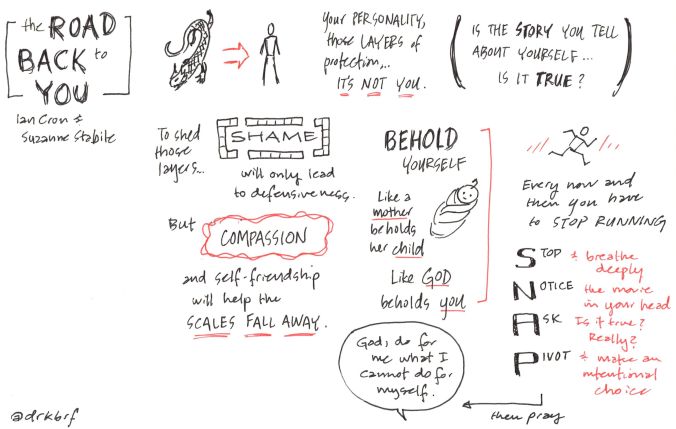
+++
Over 4 Thursday sessions (March 14 – April 25) at Nik & Dave’s house (152 Tanderra Way, Karana Downs; directions here) we will dialogue with Cron and Stabile’s The Road Back to You [RBY] and each other, teasing apart our Enneagram types and their inter-relationship, en route to discovering how to love each other for the sake of the world.
Check out the calendar below for key dates, and pick up your paperback or kindle version of RBY here.
{Want to join us virtually? We’re experimenting with Zoom so you can listen in, and share your thoughts, live streaming the experience. Download the pdf of the powerpoint slides (e.g. on schedule, e.g., click link for RBY1) to play on your computer, and then see what’s happening through a basic web-cam capture of the group. We’ll have a shared microphone so the sound won’t be great, but you should be able to hear what we’re each saying, add your own voice when you ‘unmute’ your microphone, and participate in the practices as best as we can short of teleporting materials to your living room! …
https://zoom.us/j/396017392 … Log in around 7:00pm on the fortnightly Thursday to test your sound, then start the conversation with us around 7:20-9:10pm. New to Zoom? 50 second meeting joining video here, and more detailed directions, especially for problem shooting, here.}
We have a soft-start from 6:30pm—feel free to rock up early and eat your dinner or share a cup of tea. (Park up top, on the left-hand side of our circular driveway.) At 7pm sharp we get into the night, finishing each night by 9pm with supper together and an unrushed chat over coffee. OPEN BOOK includes some basic spiritual practices and prayer, before unpacking the pre-reading scheduled for that night.
For each week, it helps to think through how the reading provokes you in 4 ways:
 1) Questions: what didn’t make sense?
2) Challenges: what did you think was wrong?
3) Implications: what difference does this make for loving each other and being a communal witness in a divided world?
4) Applications: what does it look like for us to live out of this vision, making God known by the life of our community together?

OPEN BOOK, THURSDAYS 7PM | Cron & Sabile’s The Road Back to You (RBY)
(Click session # hyperlink for liturgy/ppnt slides–e.g., RBY 1 below–and page numbers for the next reading. Virtual/Zoom participation via https://zoom.us/j/396017392.)
March 1 | Pre-series Open Table dinner, on the theme of “Superheroes“. Who did you always want to be? What’s your superpower? Or your kryptonite? How do these strengths and weaknesses travel together in a purpose-full life lived to “save the world”? At Andrew & Liz Nichols’ house (155 Burbong St. Chapel Hill; call Liz on 0415624982 if lost!).
March 14 | RBY 1, pp. 9-62: Ch. 1 “A Curious Theory of Unknown Origin” (9-20), Ch. 2 “Finding Your Type” (21-39), and Ch. 3 “Type Eight: The Challenger” (40-62).
March 28 | RBY 2, pp. 63-128: Ch. 4 “Type Nine: The Peacemaker” (63-89), Ch. 5 “Type One: The Perfectionist” (90-109), and Ch. 6 “Type Two: The Helper” (110-128).
April 11 | RBY 3, pp. 129-187: Ch. 7 “Type Three: The Performer” (129-147), Ch. 8 “Type Four: The Romantic” (148-166), and Ch. 9 “Type Five: The Investigator” (167-187).
April 25 | RBY 4, pp. 188-230: Ch. 10 “Type Six: The Loyalist” (188-204), Ch. 11 “Type Seven: The Enthusiast” (205-225), and Ch. 12 “So Now What? The Beginning of Love” (226-230).
May 10 | Open Table dinner, on the theme of “Wisdom of Our Elders“. Who has impacted your life the most as a mentor? We’ll explore stories of ageing, what we’ve learned from those who’ve lived well and also would rather forget from our grumpy forebears. Generally, we’ll trade hard earned wisdom that gave many their grey hairs! Location at Nathan and Melissa McConaghy’s place (69 Sunset Rd., Kenmore, 4069).
Hope to see you there!


 In the Greek, there are three key words for “
 Paradoxically, sometimes this quality of the “life of the ages” comes via dying, rather than striving to preserve one’s physical existence at all costs: “If you cling to your life, you will lose it; but if you give up your life for me, you will find it” (Matthew 10:39). In this way of being, “to live is Christ, and to die is gain” (Philippians 1:21). This is powerfully captured by the German artist, Hans Holbein, in his 1522 masterpiece, “The Body of the Dead Christ in the Tomb.”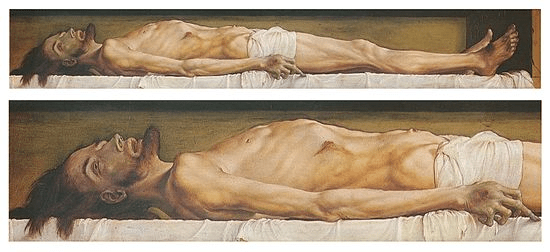
 Consider, also, the many biblical reflections on sacrifice, atonement and resurrection, where through the Messiah dying on our behalf, death itself was defeated–in C. S. Lewis’s







 What do I mean by Profit & Loss? Well, hopefully the stimulus will provoke you to recall and share personal stories of being in plenty and want, wealth and poverty, handling money wisely, resisting the greedy lure of mammon in our post-GFC world [Global Financial Crisis, as poignantly captured by the movie,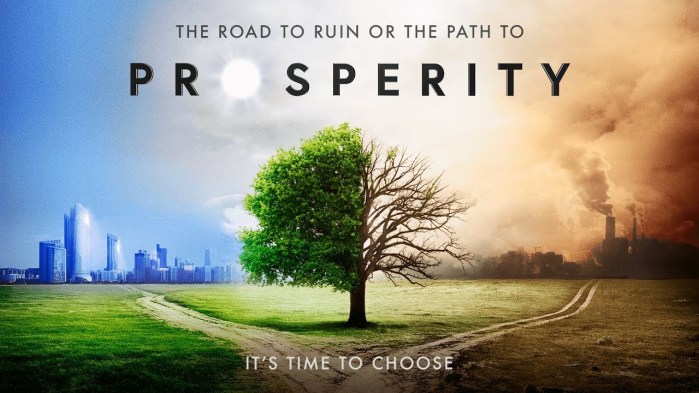
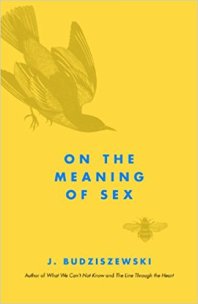
 In our second cycle for 2018 (starting Thursday 24th May), we tackle the vexed question of sexuality. Unless you’ve been hiding in a closet since the 1960s, it’s pretty evident that a lot has changed when it comes to sex. All our mores and most every moral has come up for scrutiny, from the taken-for-granted (though rarely practiced) Christian line of no sex before marriage and life-long complementary union “until death do we part”, to the norm of nuclear families purposed for bearing children. We live in the age of no-fault divorce, friends with benefits, sexting in schools and “torture porn” on TV (think “Game of Thrones”), Tinder hook ups, LGBTIQA+ multiplying identities, safe schools and gender education normalising dysphoria, gay pride and homosexual marriage, surrogacy, contraception and over-the-counter abortifacents, partner swapping, and the sexual revolution rolls on.
 What a travesty to treat “sexuality” as a problem, when it was one of God’s foundational gifts to those bearing his likeness. And yet, we must step back, looking with fresh eyes at both the culture and the Scriptures, to discern how God may be at work in this particularly turbulent period where religion is taboo and confined to one’s private quarters, while what was hidden in the bedroom is now public politic.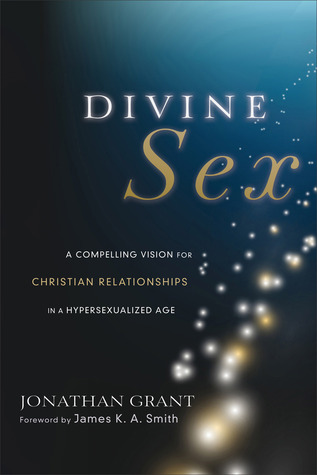

 For some excellent reviews of Divine Sex (DS)–if the wide-ranging commendations on the back-cover don’t cut it for you–check these out:



 “Wanderlust” [
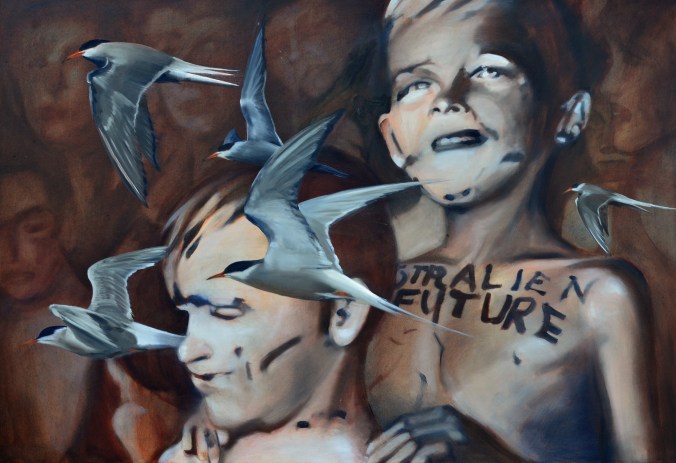
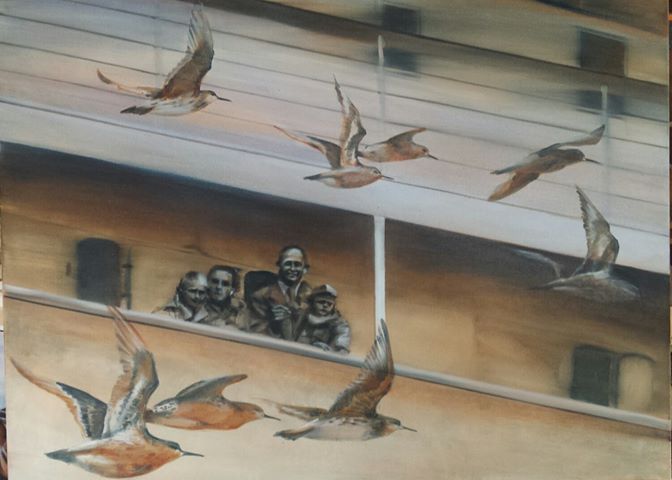
 The desire to move about thus takes on a different hue when we consider mass migration in this era of the refugee. Unprecedented numbers of people are streaming across Europe, and occasionally reaching our shores, out of foreign cultures such as Afghanistan, Sri Lanka, and Syria. While debates rage at “home” about what makes for a refugee as distinct from an “economic migrant”, this is hardly a case of wanderlust. The price paid is immense, to uproot from the known (however decimated it may now be), and set out to a new land without the money and language and networks to make any plans that guarantee safety, let alone a better life. Unsurprisingly, many of these children dream of returning to their homeland, and rebuilding what was to recapture their sense of identity and stability. (Take for instance,




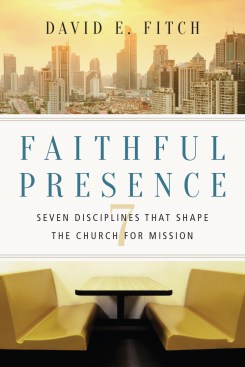
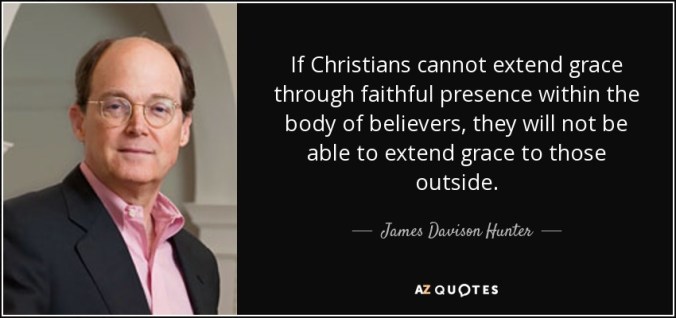
 Thank God, then, for Fitch. He steps in with a more embracing theological vision of God’s faithful presence across biblical history. He presses back on Hunter, revealing that the church itself, in its very inner life and rhythms when rightly constituted, is a counter-politic embodying God’s peace-full reign. And that’s all by Chapter 2. (For a 3 minute grab of why Fitch thinks we must move “from gospel presentation to kingdom presence” see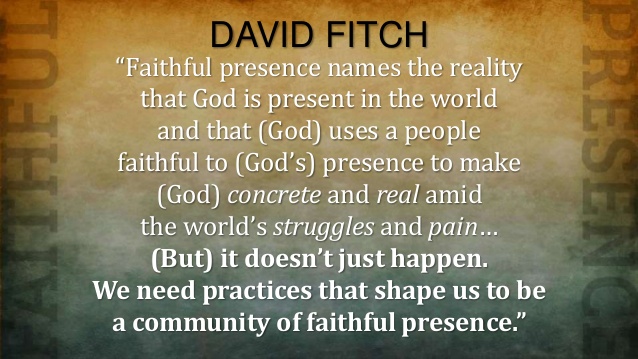
 Reconciliation (peace-making)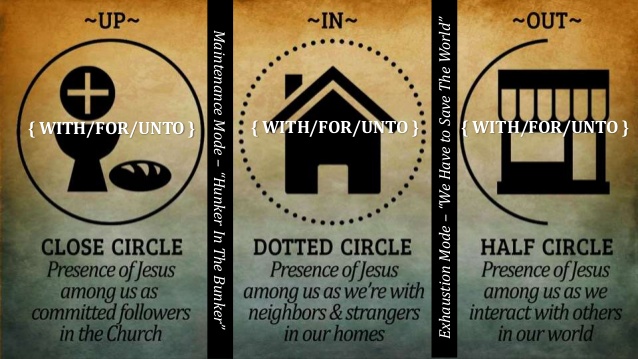


 As one who loves rock-climbing, snapped his neck in a gymnastics accident, and still commutes on a motorbike most every day, I get this
  Definitions vary, but pay attention to the valence. Risk has a negative aspect. It’s the possibility of loss or injury: peril; someone or something that creates or suggests a hazard. In other words, risk is the exposure to the likelihood of injury or loss; put simply, it’s a dangerous and chancy choice.
 It’s no artificial segueway to see that this is now about that. This worldly risk is also about that greater good. As
  Turning to the biblical story, then, we might rightly wonder if the Triune God—Father-Son-Spirit—is prone to risk-taking? Can God even take a risk, given the above definition? If you hold to the medieval philosophical framing of God being, by definition, omniscient (all knowing), omnipotent (all powerful), omnipresent (everywhere), and ultimately
 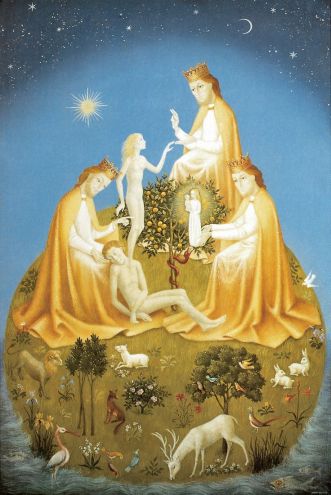 Test case: Creation. The all-sufficient Risk-Taker whose essence is communion, overflowed in the perichoretic dance to creatively birth the cosmos. The motivation was love, and the reward was shalom, weaving us together through right relationship with God, neighbour, self and creation, all pointing back to its transcendent source. The risk is for everyone, not simply God in a zero-sum game; holistic flourishing, like African
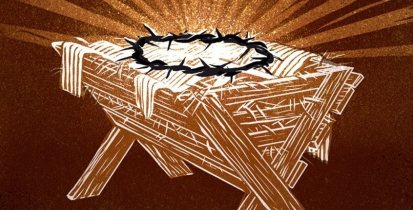
 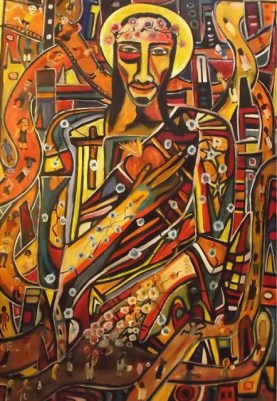 Like I said, though, Christmas is a time of injury.
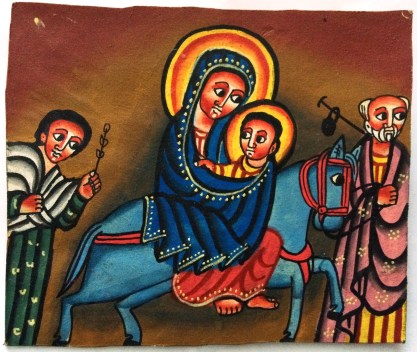 The unlimited, all knowing, all powerful Creator, tied himself to matter and was confined to a crib in a baby’s body. God hurt. And forget those romanticised Christmas carols: “meek and mild, no crying he makes”. No, this was first century Palestine, no more peaceful than today (cf.
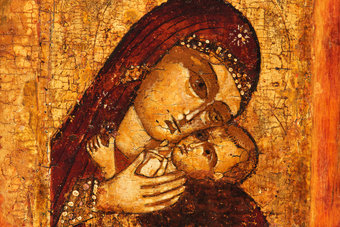
  It’s captured well in the iconic Greek Orthodox painting “Slaughter of the Innocents”. Granted, the statistics suffer symbolic inflation over this feast honouring the “
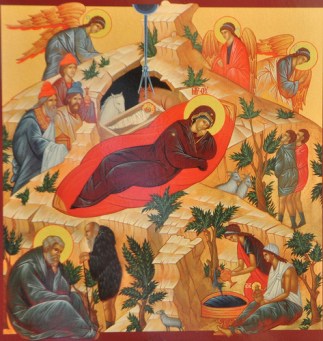 The risk of incarnation led inexorably to the crucifixion, the final relinquishment of divine power, not for personal gain, but that all may be set free from the ultimate demonic despot, finding life in renewed relationship with God, neighbour, planet and self. Literally, this risk offered a sign, a fore-taste, of “
 Transposed into the modern world, where facing today’s Herods requires the combined courage of Mary and the Messiah, Chesterton composed this poem:
 And the mother still joys for the whispered
 Returning, then, to our key theme, and inspired by Parker Palmer’s
  Our conversation partner is the Argentinian, Jorge Mario Bergoglio. You likely know him better as the 266th Sovereign of Vatican City, Pope Francis (or Papa Francesco as Italians fondly call him), who took his name from the nature loving
 Christ's Pieces